

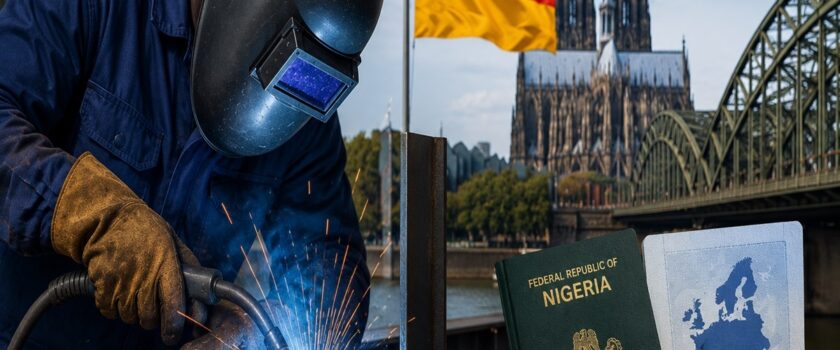
Welder Jobs in Germany with Visa Sponsorship for Nigerians: 2026
Welder Jobs in Germany with Visa Sponsorship for Nigerians. 2026
If you’re a welder in Nigeria — whether you trained at a polytechnic, picked it up at a workshop in Trans Amadi, or learned on the job at a Lagos fabrication yard — you’ve probably heard people talk about moving abroad. Some have made it. Others are stuck waiting on agents who never call back. but welder jobs in Germany with visa sponsorship for Nigerians are available in Apex Global Career.
Here’s the truth: welder jobs in Germany with visa sponsorship for Nigerians are absolutely real in 2026, and the path has actually gotten easier in the last two years. Germany changed its immigration laws specifically to attract skilled tradespeople from outside the EU, and Nigerians with the right skills and paperwork are getting through.
But there’s also a lot of misinformation floating around — agents charging fees they shouldn’t, fake offers, and shortcuts that lead nowhere. This guide cuts through all of that. I’ll walk you through exactly how visa sponsorship works, what you’ll actually earn in Naira, the documents you need, and how to spot scams before they cost you money.
If you want the bigger picture of working as a welder in Germany — daily life, work culture, types of jobs — read our complete welding jobs abroad overseas guide first. This post focuses purely on the Nigeria-specific path.
Why German Employers Are Actively Hiring Nigerian Welders
Let’s start with something that might surprise you: German employers aren’t doing Nigerian welders a favour. They genuinely need you.
Germany has one of the worst skilled-worker shortages in Europe. Their own welders are retiring, fewer young Germans are going into the trade, and projects are sitting unfinished because there aren’t enough hands. Nigerian welders — especially those with experience in oil and gas, pipeline work, and structural fabrication — bring exactly the skills German employers can’t find at home.
What works in your favour as a Nigerian welder:
- Strong technical background — Nigerian-trained welders working in oil and gas often have skills above what’s typical in Europe.
- English proficiency — you skip the language barrier that holds back applicants from other non-EU countries.
- Work ethic reputation — Nigerian tradespeople have built a strong name in international labour markets over the past decade.
- Familiarity with international standards — if you’ve worked with Shell, Total, Chevron, NLNG, or any of their contractors, you already know the codes Germans use.
The Skilled Immigration Act and the Chancenkarte (Opportunity Card)
This is the part that changed everything for Nigerians in 2024–2025, and it’s the law you need to understand.
Germany now offers two main routes for Nigerian welders:
Route 1: Skilled Worker Visa (with a job offer) You apply after a German company has offered you a contract. Your employer sponsors the visa, and you arrive ready to start work.
Route 2: Chancenkarte (Opportunity Card) This is a points-based card that lets you enter Germany for up to one year to look for work in person. You score points based on qualifications, work experience, language skills, age, and ties to Germany. If you reach the minimum points, you can come, job-hunt, and convert to a full work visa once you find an employer.
| Route | Best For | Time to Approve | Cost (Approx) |
|---|---|---|---|
| Skilled Worker Visa | Welders with a confirmed job offer | 6–12 weeks | €75 visa fee + document costs |
| Chancenkarte | Experienced welders without an offer yet | 4–8 weeks | €75 visa fee + proof of funds |
Most Nigerian welders go for Route 1 — it’s faster, cheaper, and you arrive with income already secured. Route 2 is useful if you can afford a year of self-funded job hunting.
Real Salaries: What Welders Earn in Germany vs Nigeria
This is probably the section you scrolled down for. Here’s an honest, like-for-like comparison.
Exchange rates fluctuate, so the Naira figures below are illustrative and use an approximate rate of 1 EUR = ₦1,800. Check the current rate before making any decisions.
| Welder Level | Germany (Annual, Gross) | Nigeria (Annual, Approx) | Difference |
|---|---|---|---|
| Entry-level | €25,000 – €29,000 (~₦45M – ₦52M) | ₦1.8M – ₦4M | ~10–25x more |
| Mid-level | €30,000 – €38,000 (~₦54M – ₦68M) | ₦4M – ₦8M | ~7–15x more |
| Senior / Certified | €37,000 – €46,000 (~₦67M – ₦83M) | ₦8M – ₦15M | ~5–10x more |
| 6G Pipe Welder | €45,000 – €55,000+ (~₦81M – ₦100M+) | ₦12M – ₦25M (rig work) | ~4–8x more |
A few honest points to factor in:
- Germany’s cost of living is significantly higher than Nigeria’s. Rent, food, transport, and utilities will eat into that gross salary.
- After tax and social security, take-home is typically 60–70% of gross.
- Even after all deductions and living costs, the savings potential is several times higher than in Nigeria — especially if you live simply for the first 1–2 years.
Most Nigerian welders I’ve heard from say they save €600–€1,200 per month after expenses in their first year, which is more than many of them earned monthly in Nigeria.
Documents You’ll Need (And How to Get Them in Order)
This is where most Nigerian applications fall apart — not because of skill, but because of paperwork. Get this right and you’re 80% of the way there.
| Document | Where to Get It | Notes |
|---|---|---|
| International passport | Nigeria Immigration Service | Must be valid for at least 12 more months |
| Welding certifications | Issuing body (NABTEB, City & Guilds, etc.) | Originals plus translations to German if not in English |
| Trade test certificate | Federal Ministry of Labour | Required for skill recognition |
| Educational certificates | Your school + Ministry of Education | Must be authenticated |
| CV in European format | Self-prepared | Use Europass format — Google “Europass CV template” |
| Reference letters | Past employers | Ideally on company letterhead with phone contacts |
| Proof of work experience | Past employers / pension records | Pay slips help here |
| Police character certificate | Nigeria Police Force HQ | Valid for 6 months |
| Birth certificate | National Population Commission | NPC original, not affidavit |
| Apostille / authentication | Federal Ministry of Foreign Affairs | Critical step — see below |
The apostille step is the one most applicants skip. Germany requires Nigerian documents to be authenticated through the Ministry of Foreign Affairs in Abuja and then legalized by the German Embassy. Without this, your documents won’t be accepted for the visa interview. Budget 4–8 weeks for this process alone.
Step-by-Step: How the Visa Sponsorship Process Actually Works
Here’s the realistic timeline from “I’m interested” to “I’m working in Germany”:
| Step | What You Do | Timeline |
|---|---|---|
| 1. Prepare documents | Gather, translate, and apostille your paperwork | 4–8 weeks |
| 2. Apply to verified recruiters | Submit CV to legitimate German recruitment platforms | 1–2 weeks |
| 3. Skills interview | Video call with recruiter, sometimes a welding test video | 1–3 weeks |
| 4. Employer interview | German employer interviews you (usually via Zoom) | 2–4 weeks |
| 5. Job offer & contract | You receive a signed contract with salary details | 1–2 weeks |
| 6. Qualification recognition | Submit qualifications to ZAB for Anerkennung | 4–12 weeks |
| 7. Visa appointment | Book at German Embassy in Abuja or Consulate in Lagos | 2–8 weeks wait |
| 8. Visa interview | Attend in person with all documents | 1 day |
| 9. Visa approval | Receive visa sticker in passport | 4–8 weeks after interview |
| 10. Travel & start work | Fly to Germany, register, begin job | 1–2 weeks after visa |
Realistic total: 6 to 9 months from start to landing in Germany. Anyone telling you “two weeks” is lying to you.
Estimated Costs of Relocation from Nigeria
You should expect to spend money on this process. Anyone telling you it’s free is selling you something else.
| Item | Estimated Cost (NGN) |
|---|---|
| Passport (if renewing) | ₦35,000 – ₦100,000 |
| Document authentication & apostille | ₦80,000 – ₦200,000 |
| Translations (German) | ₦50,000 – ₦150,000 |
| Police character certificate | ₦15,000 – ₦30,000 |
| Visa fee (€75) | ~₦135,000 |
| Travel to Abuja/Lagos for embassy | ₦50,000 – ₦150,000 |
| Flight to Germany (one way) | ₦1,200,000 – ₦2,500,000 |
| Initial settling-in funds | ₦1,500,000 – ₦3,000,000 |
| Total realistic budget | ₦3,000,000 – ₦6,000,000 |
A legitimate recruiter usually covers some of this (sometimes the flight and first accommodation). But you should plan as if you’ll cover everything yourself — that way any help is a bonus, not a dependency.
How to Avoid Welder Job Scams (This Section Is Important)
Nigeria has a serious problem with fake recruitment agents charging huge fees for “guaranteed visas” that never materialize. I’ve seen people lose ₦2 million to ₦5 million to these scams. Don’t let it happen to you.
welder jobs in Germany with visa sponsorship for Nigerians.
Red flags that mean you should walk away immediately:
- They ask for a large upfront “processing fee,” “visa fee,” or “training fee” before any interview.
- They guarantee a visa or a job. No legitimate agency can guarantee either.
- They have no verifiable company address in Germany.
- Their website was registered less than a year ago.
- They use Gmail or Yahoo email instead of a company domain.
- They pressure you to “act fast” or “pay today to secure your slot.”
- They can’t tell you the name of the German employer until you’ve paid.
- They claim connections at the embassy who can “speed things up.”
Green flags that suggest a legitimate recruiter:
- They have a registered office in Germany (you can verify on the German trade register, Handelsregister).
- The employer — not you — pays their recruitment fee.
- They provide a written contract before any payment from you.
- They’re transparent about the timeline and don’t promise miracles.
- They have verifiable past placements you can talk to.
- Their communications come from a company domain email.
Rule of thumb: if the agent is making more money from you than from the employer, they’re not a recruiter — they’re a salesperson selling you hope.
Tips That Actually Help Nigerian Welders Get Hired
These are the practical things that move applications forward:
1. Record a welding video. Two to three minutes of you running clean beads on different positions (1G, 3G, 6G if you can). This single piece of evidence beats any certificate.
2. Get your trade test done if you haven’t. A Federal Ministry of Labour Trade Test certificate carries weight internationally. If you don’t have one yet, get it before applying.
3. Learn German basics now. You can start free on Duolingo or YouTube. Even reaching A1 level before your interview makes you stand out from other candidates.
4. Be honest about your level. Don’t claim 6G if you only do 1G. The Germans will test you on arrival, and getting caught is worse than not claiming the skill.
5. Apply to multiple recruiters, but don’t pay multiple recruiters. Comparing offers is smart. Paying three agencies for the same service is being scammed three times.
6. Get your medical fitness in order. Some German employers require a basic medical check. Sort your eyes, blood pressure, and general health before applying.
7. Plan for the first three months. Even with a job, the first paycheck in Germany usually arrives 4–6 weeks after starting. You need savings to cover the gap.
Frequently Asked Questions
Can I move to Germany as a welder without a job offer? Yes, through the Chancenkarte (Opportunity Card), if you meet the points requirement. You get up to one year to find work in person.
Do I need to speak German to get a welder job in Germany? Not always. Many large companies operate in English, and some employers offer free German classes after you start. But basic German makes everything easier.
How much does it cost to relocate from Nigeria to Germany as a welder? Budget realistically between ₦3 million and ₦6 million. A good recruiter may cover flights and first accommodation, but plan for the full amount yourself.
Will my Nigerian welding certificate be recognised in Germany? Often yes, through the formal recognition process called Anerkennung. If it’s not recognised directly, you can take a German welding test on arrival.
Can I bring my wife and children with me? Yes. Germany allows family reunification once you have a stable job and adequate housing. Spouses get work permits and children get free public schooling.
How long does the whole visa process take? Realistically, 6 to 9 months from when you start gathering documents to when you arrive in Germany.
What’s the safest way to find a legitimate recruiter? Look for German-registered companies with verifiable office addresses, transparent fee structures (employer pays, not you), and traceable past placements. Verify them on the Handelsregister.
Final Thoughts
Welder jobs in Germany with visa sponsorship for Nigerians are one of the most realistic pathways out of Nigeria right now — more realistic than tech, sometimes more realistic than nursing, and definitely more realistic than visa lottery dreams. The skill is in demand, the legal pathway exists, and Nigerian welders have a strong reputation in international labour markets.
But it’s not magic. You need real skills, real documents, real patience, and the discipline to avoid the scams that target ambitious people every day.
If you’re serious, start with these three steps this week:
- Renew your passport if it expires within the next 18 months.
- Get your trade test certificate sorted if you don’t have one.
- Start gathering and authenticating your documents — that 4–8 week timeline is unavoidable.
Then apply to one or two verified recruiters and see what comes back. The whole process from today to your first day on a German jobsite is closer than most Nigerians realise.
List of verified Job Listing sites to apply for foreign jobs Abroad
Afolayan Olakunle Joseph
June 10, 2026 at 5:38 pmI’m into welding and fabrication steel 7 years experience willing to work under pressure and work with a group of teams to achieve our goal.
Daniel Usoh Assamudo
July 27, 2026 at 1:45 pmI am Arc- welder. I just needed a welding work, I have about 7 years experience on welding work
Mizanul Babu
July 27, 2026 at 6:57 pmI am welder need a job
Nwanchor Chukwuebuka
August 5, 2026 at 10:58 pmI’m into welding in Nigeria 5 years experience willing to work
charles fundi
June 30, 2026 at 7:21 amam qualified skilled welder kindly get me a job
Eyitimibai Godspower Tarilayefa
July 4, 2026 at 11:28 amPlease I need an assistant to get a welding job with a Visa sponsorship
Mizanul Babu
July 27, 2026 at 6:58 pmI am welder need a job
Nwanchor Chukwuebuka
August 5, 2026 at 10:59 pmchukwuebukanwanchor00@gmail.com
Neresh Mandel
August 15, 2026 at 10:51 amAnit welder job
Ramzan Baqar
August 24, 2026 at 5:28 amHello sir my name is Ramzan baqar I’m from Pakistan I have 10 year experience in welder 6G 6GR I need job please help me thanks.